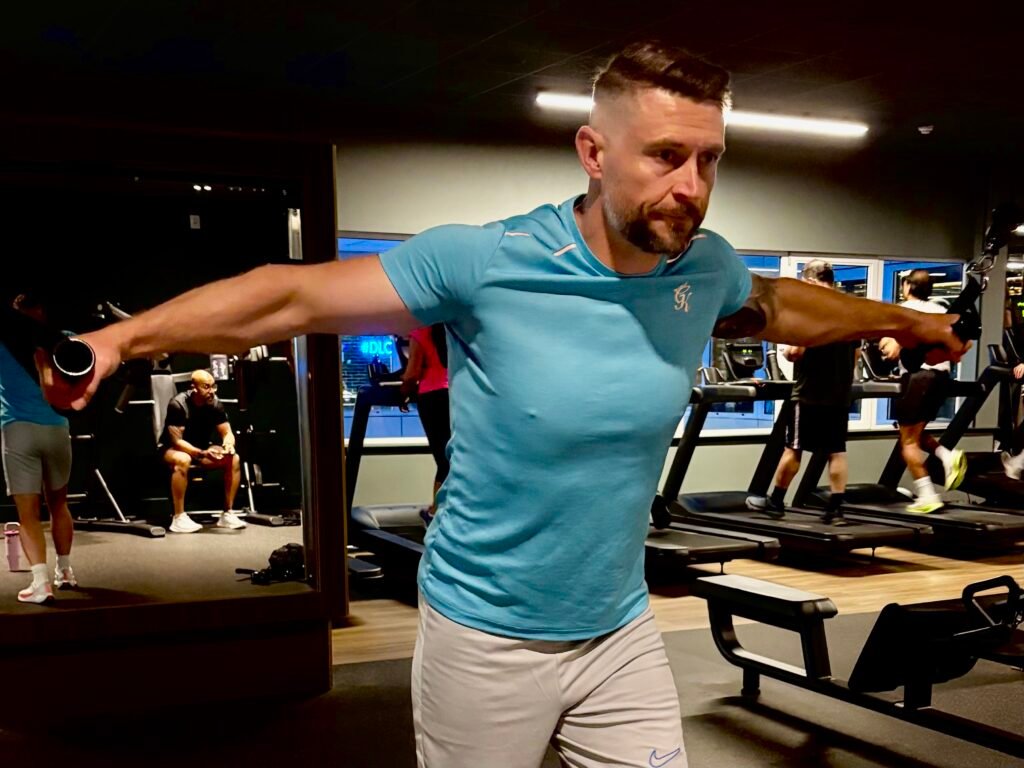
How Can I Get a Mind-Muscle Connection When Working My Chest? (6 Techniques, Tips and Workout)
If you can push the weight but can’t actually feel your chest working, you’re leaving gains on the table. For a lot of people the shoulders and triceps end up doing the job the chest should be doing — and the bar still moves, so the problem goes unnoticed.
The good news is that the mind-muscle connection is a skill, not a gift. You can build it. Here are six techniques that work, a couple of extra tips, and a simple workout to put it all into practice.
How Can I Get a Mind-Muscle Connection When Working My Chest?
To build a mind-muscle connection with your chest, slow your reps down, drop the weight enough that you can actually feel the muscle rather than just shift the load, and focus hard on squeezing the chest through every rep. Practising flexing your chest outside the gym, lightly touching the muscle as you train, and visualising it working all speed the process up. It takes patience — but feeling your chest work is the difference between moving weight and actually growing.
What the mind-muscle connection actually is
The mind-muscle connection is simply your ability to consciously focus on a muscle and feel it contract as you train it. It matters because when you genuinely engage the target muscle, you recruit more of its fibres, you keep other muscles from taking over the movement, and you tend to use better form — which means better growth and fewer niggles. For the chest specifically, it’s the thing that stops every pressing movement turning into a shoulder-and-triceps exercise.
6 techniques to build it
1. Slow your reps right down
Momentum is the enemy of feel. Lower the weight slowly and under control — especially the lowering (eccentric) phase — and the chest has no choice but to do the work. Fast, bouncy reps let the muscle off the hook.
2. Drop the weight and chase the squeeze
Ego-lifting kills the mind-muscle connection. Use a weight light enough that you can focus on contracting and squeezing the chest at the top of every rep, rather than just heaving the load from A to B. You can build the weight back up once you can feel it.
3. Flex your chest — in and out of the gym
Practising flexing your chest through the day trains your brain to find and fire those muscles on demand. Then, just before a set, give the chest a hard flex so it’s already “switched on” when you start the movement.
4. Touch the muscle as you train
Lightly placing a hand on your chest (or having someone else do it) gives you tactile feedback that pulls your focus straight to the muscle and helps you confirm it’s actually firing. It’s one of the most underrated techniques there is.
5. Isolate it with machines and single-arm work
Machines like the pec deck and cable crossover hold your body stable so you can focus purely on the chest, and single-arm movements (one-arm cable press or crossover) let you concentrate fully on one side at a time. Both are brilliant for finding the feeling before you take it back to the big lifts.
6. Visualise it working
Before and during each rep, picture your chest fibres contracting and shortening as you press, and stretching as you lower. It sounds woo, but mentally rehearsing the contraction genuinely improves how well you engage the muscle.
Two quick extra tips: warm the chest up first with a few light, focused sets so it’s awake before you load it — and experiment with bench angle and grip width, since small changes can dramatically alter where you feel the work.
Related: Why Is My Inner Chest Not Growing?
A coach’s perspective
This is a question I hear a lot around the gym, because a chiselled chest is something us boys dream of from the moment we first lower that barbell towards our chest. Let’s be under no illusions — I was there too, and I’d always love my bench press to be better. But with the functional fitness routine I’m on at the moment, I don’t have the capacity or the need to chase bench PBs.
What I’ve found, though, is that the best way to build a stronger mind-muscle connection with your chest is to get back to basics. By that I mean starting with a blank slate and really reducing the weight to begin with. One thing I noticed when I was pushing my limits on the bench was that I felt the exercise more in my front delts — because when you start lifting too heavy, your body automatically compensates and tries to get you out of trouble, finishing the rep as quickly and efficiently as it can.
One of the biggest changes for me was slowing the movement right down and pressing from a lower position. That’s harder than it sounds, because over time you naturally pick up bad habits and end up benching too high up the chest, which brings the front delts into play.
A mate at the gym noticed and told me to lower the bar to the lower part of my pecs rather than the middle. It instantly felt like a completely different movement — and it humbled me. But it also got me feeling that contraction in my chest straight away, and my chest hadn’t been that sore the day after a session in years!
One of the best ways to build on this is the decline bench press — at that angle you really feel the squeeze across your pecs, and you get a fantastic pump to boot. And don’t overlook volume: to break through the plateau we all hit, especially on bench, aim to train the chest twice a week for proper gains.
A workout to build your chest mind-muscle connection
Use light weights and focus entirely on feeling the chest work, not on the numbers. Do this once or twice a week as part of a balanced programme.
Warm-up:
- 5 minutes light cardio
- Arm circles — 2 sets of 10 each direction
- A few light, slow press reps to wake the chest up
Main workout:
- Single-arm dumbbell chest press — 3 x 12 each arm. Place your free hand on the working pec to feel it contract.
- Pec deck — 3 x 15. Lighter weight, hard squeeze at the end of each rep.
- Cable crossover — 3 x 15. Slow and controlled, focus on the chest drawing across.
- Push-ups with slow negatives — 3 x 10. Lower slowly, press up with intent.
- Dumbbell flyes — 3 x 12. Slight bend in the elbows, think “hugging a tree,” feel the stretch and squeeze.
- Isometric chest squeeze — 3 x 10–15 second holds. Press your palms together hard in front of your chest and squeeze the pecs.
Cool down:
Chest stretch — arms out to the sides, palms forward, press the chest forward and hold 20–30 seconds.
FAQs
How do you build a mind-muscle connection with your chest?
Focus mentally on the chest as you train, use lighter weights so you can actually feel it working, slow your reps down, and practise flexing the chest outside the gym. Touching the muscle and visualising it contracting both help too. It’s a skill that builds with consistent practice.
Why can’t I feel my chest when I bench or press?
Usually because your shoulders and triceps are taking over the movement — often from going too heavy, flaring the elbows, or rushing the reps. Drop the weight, slow down, tuck the elbows slightly, and consciously drive through the chest. Pre-flexing the chest before a set helps it fire first.
How long does it take to build a mind-muscle connection?
It varies, but with focused practice most people start noticing a clearer connection within a few weeks. Like any skill, it’s about regular, deliberate practice rather than the odd session of trying hard.
Related: What are the benefits of the pause bench press?
Final Thoughts…
Feeling your chest work, rather than just moving weight, is one of the biggest differences between training hard and training well. Slow your reps, lighten the load, flex and touch the muscle, isolate it with machines, and picture it working — and give it time. Build the connection, and your chest training changes completely.
If you love training and want to get stronger — in body and mind — you’re in the right place. Here at Sport CBDs we train hard and do things properly. Head over to the YouTube channel for regular workouts plus mindset and mindfulness content to keep your head right, and if you want to build a serious grip, check out my grip strength book — everything I’ve learned about building a crushing grip, all in one place: Iron Grip.
Until next time, all the best…