Are Bicep Curls Bad for the Rotator Cuff? (Causes & How to Protect Your Shoulders)
If you’ve started feeling your bicep curls in your shoulder rather than your arm — or you’re coming back from a shoulder issue — it’s natural to wonder whether curls are bad for your rotator cuff. There’s a lot of conflicting noise about it online, so let’s clear it up.
The short version: curls aren’t the enemy. But how you do them makes all the difference. Here’s when they can put your rotator cuff at risk, and exactly how to keep your shoulders safe.
Are bicep curls bad for a rotator cuff?
No — bicep curls aren’t inherently bad for your rotator cuff. Done with sensible weight and good form, on a healthy shoulder, they’re perfectly safe. The problems start when you go too heavy and swing the weight up, curl with sloppy form, have weak or imbalanced shoulder muscles, lack shoulder mobility, or push through a shoulder that’s already injured. In other words, it’s almost never the curl itself — it’s the execution. Sort those out and you can keep building your arms without trashing your shoulders.
What the rotator cuff actually is
Your rotator cuff is a group of four muscles — the supraspinatus, infraspinatus, teres minor and subscapularis — and their tendons, which connect your shoulder blade to your upper arm. Their main job is to stabilise the shoulder joint and help you lift and rotate your arm. They’re relatively small, they work hard to keep your shoulder stable during almost every upper-body movement, and they don’t take kindly to being overloaded — which is exactly why curling badly can aggravate them.

Related: Why do I feel bicep curls in my joints?
When (and why) curls can stress your rotator cuff
1. You’re lifting too heavy and swinging it up
This is the most common culprit. Go too heavy and your biceps can’t do the job alone, so your front delts and shoulders take over — and you start swinging and using momentum to heave the weight. That extra load and loss of control leaves the rotator cuff fighting to stabilise a shoulder doing work it shouldn’t.
Fix: drop to a weight you can curl strictly and under control, with no swinging. Your ego might take a knock, but staying injury-free beats months on the sidelines.
2. Your form is off
Leaning back, flaring the elbows, shrugging the shoulders, or letting the elbows drift forward all shift the stress onto the shoulder and rotator cuff.
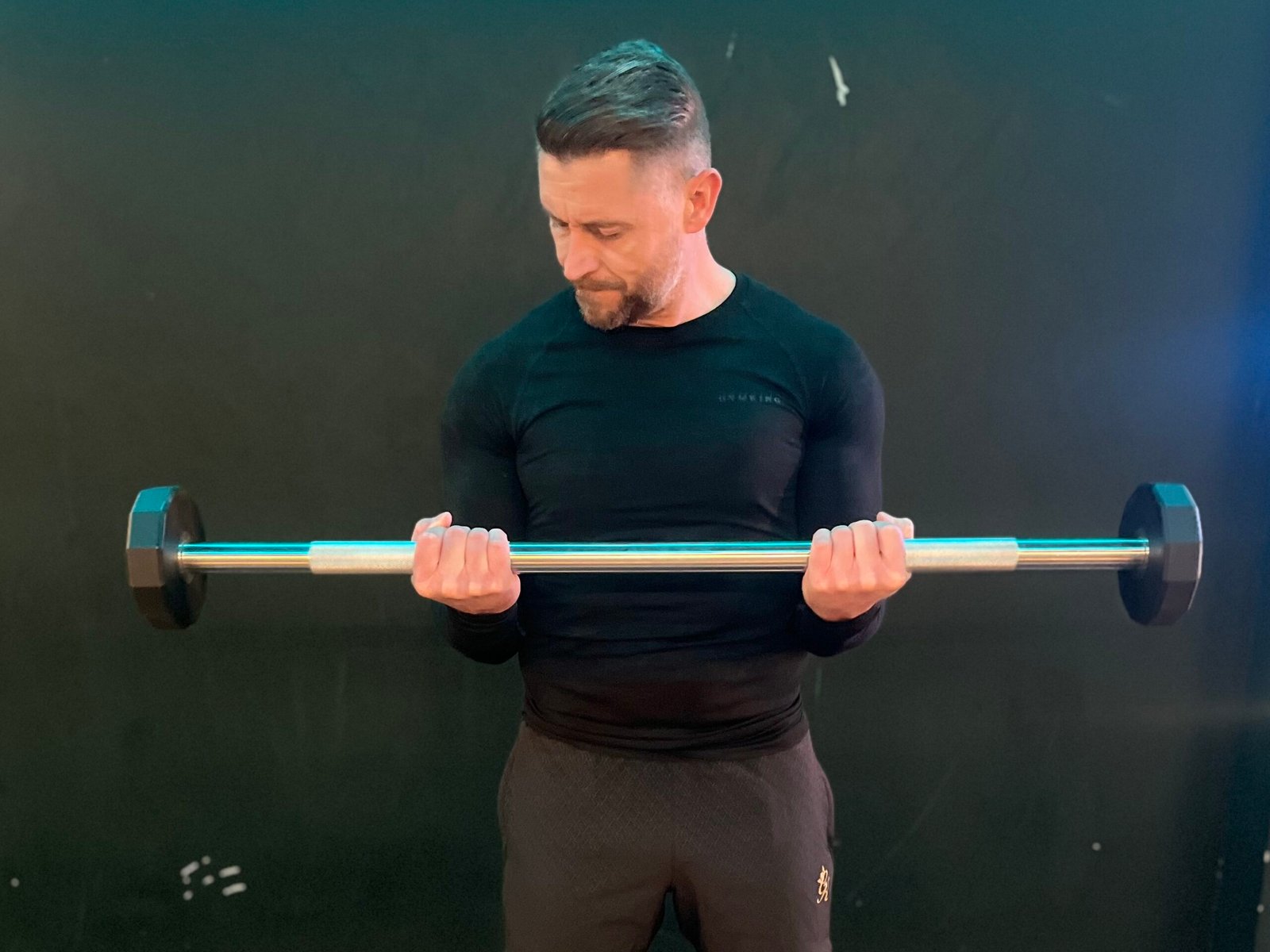
Fix: stand tall with a neutral spine, keep your elbows tucked close to your sides, move through a full but controlled range, and let your biceps — not your shoulders or back — do the lifting.
3. Weak or imbalanced shoulder muscles
The rotator cuff’s whole job is to stabilise the shoulder. If it’s weak, or there’s a big imbalance (biceps overpowering triceps, or one side stronger than the other), the shoulder is less stable and more easily strained when you curl.
Fix: train the rotator cuff directly with external and internal rotations, face pulls and band pull-aparts, and keep your training balanced — don’t neglect your triceps and back, and address any big left/right differences.
4. Limited shoulder mobility
If your shoulder can’t move freely, the joint and rotator cuff take on more stress during the curl, and you’re more likely to compensate with other muscles.
Fix: work on shoulder mobility drills, regular stretching, and a bit of foam rolling to keep the joint moving well.
5. A pre-existing injury or niggle
This is the big one. If you’ve got a current or not-fully-healed shoulder injury, curling — especially heavy — can easily aggravate it.
Fix: don’t rush back before you’ve properly rehabbed and, ideally, been cleared by a professional. And never train through sharp shoulder pain — that’s a stop signal, not something to push through.
A quick safety note
Normal muscle fatigue is one thing, but sharp, pinching, or persistent shoulder pain is not something to train through. If curls consistently hurt your shoulder, or you’ve got pain that lingers after training, stop and get it assessed by a doctor or physiotherapist. Rotator cuff issues are far easier to deal with caught early than left to grumble on for months.
A Sports Massage Therapist’s perspective
There are a few reasons people feel curls in their shoulders, but it’s normally down to ego lifting. I see it time and time again in the gym — guys picking up dumbbells to curl that I’d struggle to bench press! We all like a bit of “curls for the girls,” but you’ve got to draw the line somewhere, and I’ve got my marker pen out.
For context, I don’t really spend time curling in the mirror, because I’m happy with the work my biceps put in as a secondary muscle on compound lifts like pull-ups and rows. When I do curl, I’ll genuinely only use a 10kg dumbbell. I know what you’re thinking — “Wow, Lee, that’s pathetic!” — but I make sure I really feel the contraction and focus on the mind-muscle connection rather than the number.
Watch yourself in the mirror — not to see if you look good, but to see whether you’re swinging to get the weight up or standing statue still and using only your biceps to complete the rep. If you spot yourself swinging, I hate to break it to you, but you need to drop the weight and take a deep breath.
Obviously, if you’ve had shoulder problems in the past, be mindful of those delicate joints and consider some light work to build the surrounding strength back up. I’d always advise a bit of light mobility work to warm the shoulders up and take the edge off, and if you’re coming back from injury you need to factor your delts into that too.
People have genuinely come up to me in the gym asking why their shoulders hurt, completely oblivious to how much work those joints do every single day. Just think about it — they turn, rotate, reach and lift your arm constantly. Your shoulders are an absolute marvel, and they should be looked after, not hammered with endless exercises just to get more hench.
Personally, I always warm my shoulders up before I lift with opposite arm raises and arm circles, and I like to do dead hangs to loosen everything off before I hit the weights. They’ve genuinely helped me reduce and prevent shoulder injuries over the last few years.

Related: Why Do I Get Thumb Pain Doing Dumbbell Curls?
FAQs
Can bicep curls cause a rotator cuff injury?
Not on their own when done properly. But heavy, swung, or poorly-formed curls — especially on an already-vulnerable shoulder — can contribute to one over time. Sensible weight and strict form keep them safe.
Should I stop doing bicep curls if my shoulder hurts?
If there’s sharp or pinching pain, yes — stop and work out the cause (too heavy, poor form, or an underlying niggle). Once it’s settled you can ease back in light and strict. Any pain that lingers or keeps coming back should be checked by a professional.
How do I protect my rotator cuff while curling?
Use a weight you can control with strict form, keep your elbows tucked, don’t swing, strengthen your rotator cuff directly, and keep your shoulders mobile. Get on top of any shoulder niggles before they turn into something bigger.
Final thoughts…
So, are bicep curls bad for your rotator cuff? Not at all — not when you respect your shoulders. Use a weight you can actually control, keep your form tight, strengthen and mobilise your shoulders, and don’t push through pain or rush back from injury. Do that, and you can keep building your arms while keeping your shoulders healthy for the long haul.
Have you experienced this problem when doing curls? Let us know how these tips worked for you in the comments below!
If you love training and want to get stronger — in body and mind — you’re in the right place. Here at Sport CBDs we train hard and do things properly. Head over to the YouTube channel for regular workouts plus mindset and mindfulness content to keep your head right, and if you want to build a serious grip, check out my grip strength book — everything I’ve learned about building a crushing grip, all in one place: Iron Grip.
Until next time, all the best…